 English
 中文简体

Who Maintains Each Part of a Flow Battery Installation?
Who Maintains Each Part of a Flow Battery Installation?
Who Maintains Each Part of a Flow Battery Installation?
Who Maintains Each Part of a Flow Battery Installation?
Who Maintains Each Part of a Flow Battery Installation?
Who Maintains Each Part of a Flow Battery Installation?
Who Maintains Each Part of a Flow Battery Installation?
Who Maintains Each Part of a Flow Battery Installation?
Who Maintains Each Part of a Flow Battery Installation?
Who Maintains Each Part of a Flow Battery Installation?
Who Maintains Each Part of a Flow Battery Installation?
Who Maintains Each Part of a Flow Battery Installation?
Who Maintains Each Part of a Flow Battery Installation?
Who Maintains Each Part of a Flow Battery Installation?
Who Maintains Each Part of a Flow Battery Installation?
Who Maintains Each Part of a Flow Battery Installation?

Product Category
NEW Category
Who Maintains Each Part of a Flow Battery Installation?
An energy storage project can have a detailed equipment list and still leave a maintenance gap. The battery supplier may expect the site team to maintain an auxiliary service, while the site team assumes it is inside the supplier's scope. The problem often becomes visible only when a routine task needs an owner.
For a flow battery installation, maintenance planning should begin with the supplied configuration and its interfaces. The objective is to identify who inspects, services, authorises and documents each relevant task. This is a contract and handover exercise; the technical procedure for any activity must come from the applicable equipment documentation.
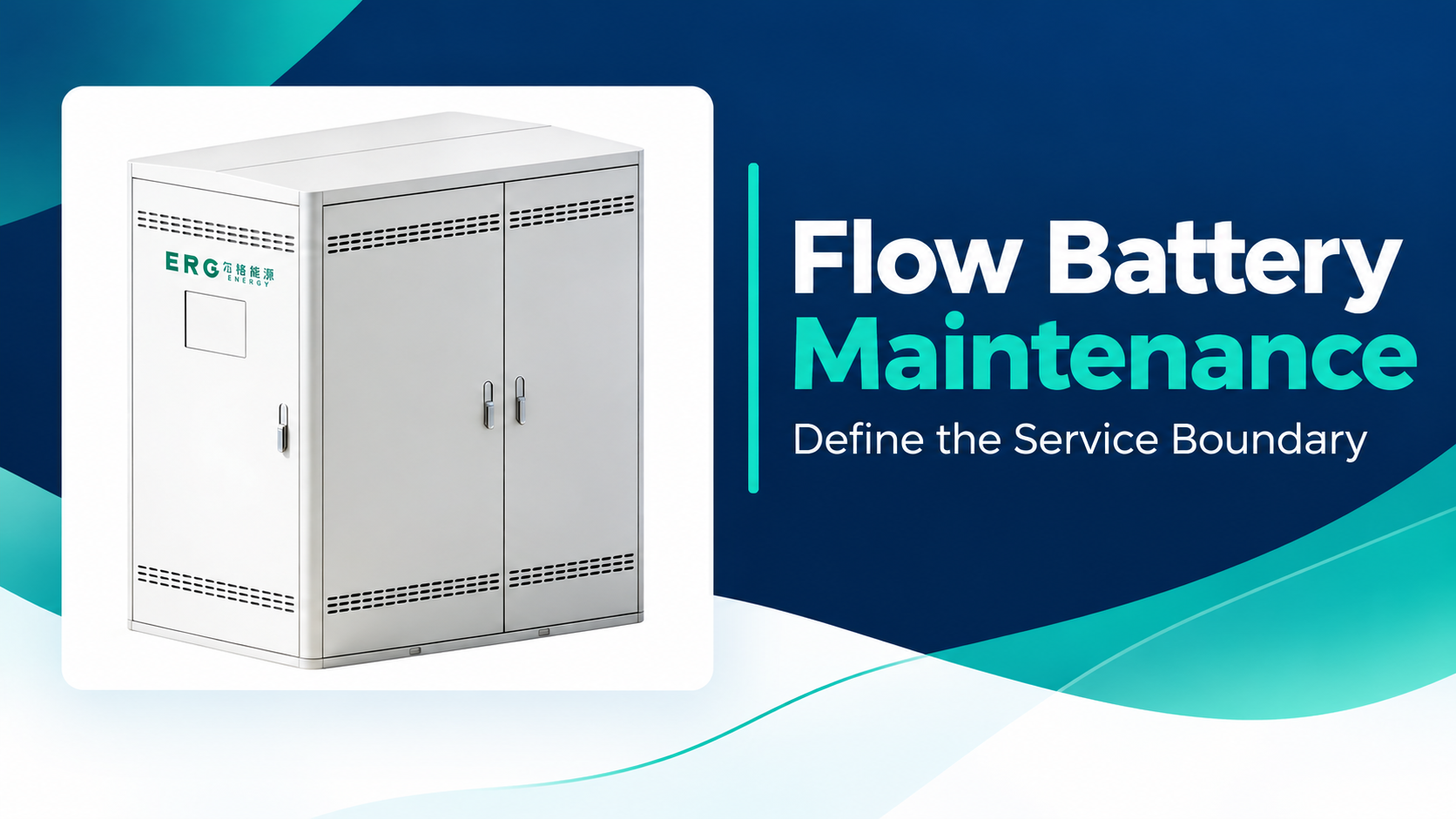
Map the actual supplied boundary
The battery energy storage systems provides a starting point for discussing the project configuration. Request the proposed system boundary and a list of included assemblies. Do not assume that every auxiliary service shown in an overview diagram is supplied or maintained by the battery vendor.
Distinguish the battery equipment from site infrastructure and any separately supplied conversion, control or connection equipment. The precise division varies by project. A useful maintenance map names the actual interfaces and responsible parties rather than relying on broad labels such as turnkey or complete system.
Include physical and information interfaces. A task may require both access to equipment and permission through a control system. The party maintaining a sensor may not be the party authorised to change an alarm setting. Those distinctions should be visible before the system is handed over.
A responsibility matrix to complete
| Interface | Question for the contract | Handover record |
|---|---|---|
| Battery equipment | Who performs documented routine tasks? | Responsible party and procedure reference |
| Auxiliary services | Which site-provided services need upkeep? | Site owner and inspection responsibility |
| Control system | Who can change settings or software? | Access rights and change-control process |
| Replacement parts | Which items are included or separately ordered? | Parts scope and replenishment route |
| Corrective service | How is specialist support requested? | Contact process and escalation boundary |
Assign tasks instead of general promises
A service statement that says maintenance included needs a defined scope. Ask which routine inspections, consumables, checks and corrective activities are covered, and which are excluded. Clarify whether labour, travel, replacement parts and specialist assistance are treated separately in the commercial agreement.
The maintenance interval should follow the equipment documentation and the agreed operating conditions. Avoid inserting a generic interval because it is common elsewhere. Environmental conditions, duty and configuration may affect the applicable schedule. Ask how the schedule is reviewed when the operating plan changes.
Keep competence and access requirements explicit
Some tasks may be appropriate for trained site personnel, while others require supplier or specialist involvement. Ask the manufacturer to identify the required competence and authorisation for each task. Attendance at a general project briefing should not automatically be treated as qualification for every service activity.
Physical access also needs review. A maintenance instruction is difficult to apply if the final installation blocks the required working space. Confirm the access assumptions during layout review and preserve them through installation. The equipment supplier and site team should resolve any conflict before the equipment enters service.
Isolation, stored energy and fluid-handling requirements must be covered by the applicable safety procedures. This article does not describe how to open, drain or service a battery system. Buyers should request the relevant documentation and training scope rather than improvising a maintenance method from a high-level description.
Define the evidence that closes a task
A maintenance record should do more than show that someone attended the site. Agree what the responsible party records: equipment identity, date, task reference, observations and any action raised. Where measurements are required, the procedure should define the method and acceptance criteria.
Record unresolved observations separately from completed tasks. An inspection can be finished while a corrective action remains open. Combining both states into a single completed entry can hide a requirement for follow-up. The handover process should make ownership and closure criteria clear for those actions.
- Connect each task to an identified assembly and procedure.
- Name the party responsible for execution and approval.
- State training, access and isolation prerequisites.
- Identify the records needed to demonstrate completion.
- Define who receives and closes unresolved findings.
A useful responsibility matrix should also address project changes. If equipment is replaced or a control function changes, someone must update the affected maintenance documents and training material. Otherwise the site may continue using a schedule or procedure that describes an earlier configuration.
Link maintenance scope to commercial decisions
Service response terms need the same precision as technical tasks. Define how a support request is raised, what information the site must provide and what the commercial response commitment actually covers. Do not translate an enquiry response target into a guaranteed repair time unless the contract explicitly provides that commitment.
Spare-parts planning should follow the approved maintenance strategy. Ask which parts the supplier recommends holding, how they are identified and what storage requirements apply. Keep recommendations separate from mandatory items and confirm whether the project price includes any initial stock.
For the owner, the practical result is a clearer operating budget and fewer unassigned interfaces. For the supplier, it is a shared understanding of the agreed service boundary. A flow battery maintenance plan becomes useful when every necessary task has an owner, an applicable procedure and a record that makes its completion assessable.
Include contractor interfaces in the same matrix. A separately appointed service company may need access permissions, current drawings and a site contact before attending. Agree who supplies those prerequisites and who updates the record after work. The presence of a service contract does not itself show that these practical arrangements have been completed.
PREV:A Lab Flow Battery Comparison Starts with a Reproducible Test Log
NEXT:Flow Battery Alarm Handover: Make the Event Record Useful
NEXT:Flow Battery Alarm Handover: Make the Event Record Useful
Interested in cooperation or have questions?

Product
Content
+86-576-83200088
No. 2, Yongxing Road, Hairun Street, Sanmen County, Zhejiang Province
Copyright © Zhejiang ERG Energy LLC. All Rights Reserved.

Customized Flow Battery ODM Services for Global Energy Storage Market