 English
 中文简体

A Lab Flow Battery Comparison Starts with a Reproducible Test Log
A Lab Flow Battery Comparison Starts with a Reproducible Test Log
A Lab Flow Battery Comparison Starts with a Reproducible Test Log
A Lab Flow Battery Comparison Starts with a Reproducible Test Log
A Lab Flow Battery Comparison Starts with a Reproducible Test Log
A Lab Flow Battery Comparison Starts with a Reproducible Test Log
A Lab Flow Battery Comparison Starts with a Reproducible Test Log
A Lab Flow Battery Comparison Starts with a Reproducible Test Log
A Lab Flow Battery Comparison Starts with a Reproducible Test Log
A Lab Flow Battery Comparison Starts with a Reproducible Test Log
A Lab Flow Battery Comparison Starts with a Reproducible Test Log
A Lab Flow Battery Comparison Starts with a Reproducible Test Log
A Lab Flow Battery Comparison Starts with a Reproducible Test Log
A Lab Flow Battery Comparison Starts with a Reproducible Test Log
A Lab Flow Battery Comparison Starts with a Reproducible Test Log
A Lab Flow Battery Comparison Starts with a Reproducible Test Log

Product Category
NEW Category
A Lab Flow Battery Comparison Starts with a Reproducible Test Log
Two laboratory runs produce different voltage curves. One uses a revised electrode, the other a different electrolyte flow setting, and both are labelled “stack test.” The curves may be real, but the comparison is difficult to interpret. A useful test log makes the changed variable visible before the result is discussed.
ERG's 20 cm² laboratory-scale vanadium flow-battery stack is described as a disassemblable platform for material evaluation and charge-discharge research. That format makes experiment identity particularly important: the hardware can be rebuilt, components can change and the same external setup can represent a different internal assembly from one run to the next.
Write the comparison question before the first cycle
State what the experiment is intended to compare. It might be an electrode treatment, membrane selection or a defined operating change. Avoid changing several of those together and then attributing every difference to a single material. If multiple changes are necessary, record them and describe the result as a comparison of configurations.
The question also determines what needs to remain constant. Flow conditions, temperature, electrolyte condition, electrical limits and conditioning history can all matter. The specific controls should follow the laboratory's validated procedure and the platform's instructions, rather than a generic checklist copied from a commercial battery installation.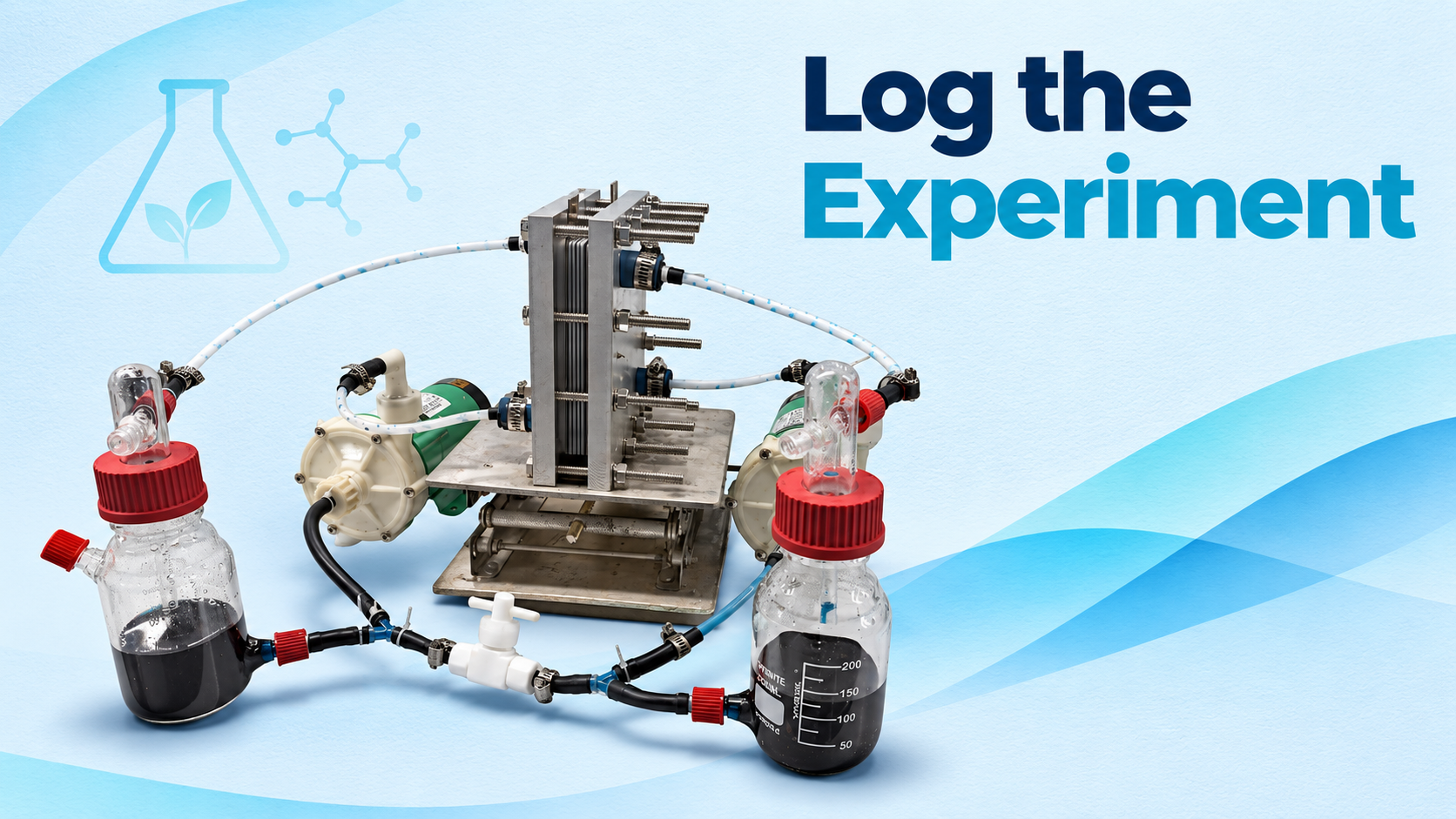
Give the assembly its own identity
The 20 cm² laboratory vanadium flow-battery stack is a product platform, not a complete experiment description. Assign a run identifier and record the actual assembly configuration. Identify the membrane, electrodes, cell arrangement and any relevant hardware revision used for the test.
Where the stack is disassembled and rebuilt, record that event. Follow the manufacturer's approved assembly and sealing procedure; do not invent compression or tightening values. A small change in assembly can affect the experiment, so a repeated product model name does not prove that two runs used an equivalent build.
| Log section | Example of information to record | Comparison risk if missing |
|---|---|---|
| Hardware | Assembly ID and component versions | Different builds treated as identical |
| Electrolyte | Composition, batch and initial condition | Uncontrolled starting conditions |
| Hydraulic setup | Flow settings and measured conditions | Material effect confused with flow change |
| Electrical protocol | Current, voltage limits and rest periods | Curves compared under different procedures |
| Measurement | Instrument identity and data timestamps | Unclear relationship between signals |
Keep setpoints separate from measurements
A pump setting is not necessarily the measured flow through the stack. A room-temperature note is not the same as the temperature of the electrolyte during cycling. Record what was commanded and what was measured in separate fields where that distinction matters to the experiment.
The same principle applies to electrical values. A programmed current and an acquired current trace serve different purposes. Identify the measurement location and the sign convention used for charge and discharge. Consistent units and timestamps make later comparison more reliable than a spreadsheet assembled from screenshots of instrument displays.
Do not turn a catalogue maximum or efficiency claim into the expected outcome of every laboratory run. Results depend on the assembly, operating window and calculation boundary. Any reported efficiency should state how charge, voltage or energy quantities were calculated and which auxiliary consumption, if any, was included.
A run sequence that leaves evidence
- Confirm the approved assembly and identify the components.
- Document the initial electrolyte and operating conditions.
- Load the agreed electrical protocol and recording settings.
- Follow the laboratory's startup and inspection procedure.
- Save raw signals together with events and operator observations.
- Preserve the calculation method alongside the reported result.
Use the laboratory's chemical-handling and electrical-safety procedures throughout. Vanadium electrolytes and the associated test equipment require appropriate controls. A compact research stack should not be described as a harmless desktop demonstration merely because its active area is small.
Record interruptions instead of smoothing them away
A stopped pump, a measurement dropout or an unexpected change in temperature belongs in the event log. Do not silently remove the affected period and present the remaining trace as an uninterrupted run. Explain any excluded data and retain the original file so the analysis can be reviewed.
Photographs can help document tube routing, instrument connections and the external assembly. They should supplement the written configuration, not replace it. An apparently identical arrangement can hide a different membrane or electrode. That is why component identity and rebuild records remain necessary even when the apparatus stays on the same bench.
File names can reinforce the experiment record. Use a run identifier that connects raw electrical data, flow observations, assembly photographs and the analysis sheet. Preserve the original instrument export before making plots or removing columns for presentation. If a calculation is revised, retain the method version with the result instead of overwriting the earlier conclusion without explanation. This is particularly useful when several researchers share one laboratory platform: the same apparatus can support different projects, and an unlabelled data folder should not become the only link between a curve and its physical configuration.
Report what the experiment actually supports
When the runs are complete, compare the documented conditions before comparing headline numbers. If an uncontrolled variable changed, identify it as a limitation or repeat the relevant test. A small laboratory stack can support valuable material and operating research, but it does not by itself validate the performance of a full commercial energy-storage system.
The final report should let another qualified researcher understand the assembly, protocol, raw data and calculation boundary. That makes a result useful beyond a single attractive curve and gives the next experiment a clear starting point rather than another ambiguous “stack test.”
PREV:5kW Flow Battery Stack: Clarify the Pipe Interface Scope
NEXT:Who Maintains Each Part of a Flow Battery Installation?
NEXT:Who Maintains Each Part of a Flow Battery Installation?
Interested in cooperation or have questions?

Product
Content
+86-576-83200088
No. 2, Yongxing Road, Hairun Street, Sanmen County, Zhejiang Province
Copyright © Zhejiang ERG Energy LLC. All Rights Reserved.

Customized Flow Battery ODM Services for Global Energy Storage Market