 English
 中文简体

Flow Battery Alarm Handover: Make the Event Record Useful
Flow Battery Alarm Handover: Make the Event Record Useful
Flow Battery Alarm Handover: Make the Event Record Useful
Flow Battery Alarm Handover: Make the Event Record Useful
Flow Battery Alarm Handover: Make the Event Record Useful
Flow Battery Alarm Handover: Make the Event Record Useful
Flow Battery Alarm Handover: Make the Event Record Useful
Flow Battery Alarm Handover: Make the Event Record Useful
Flow Battery Alarm Handover: Make the Event Record Useful
Flow Battery Alarm Handover: Make the Event Record Useful
Flow Battery Alarm Handover: Make the Event Record Useful
Flow Battery Alarm Handover: Make the Event Record Useful
Flow Battery Alarm Handover: Make the Event Record Useful
Flow Battery Alarm Handover: Make the Event Record Useful
Flow Battery Alarm Handover: Make the Event Record Useful
Flow Battery Alarm Handover: Make the Event Record Useful

Product Category
NEW Category
Flow Battery Alarm Handover: Make the Event Record Useful
An alarm appeared during a commissioning discussion, but the handover record contains only a screenshot and a short message saying the condition cleared. Later, the operating team cannot identify the equipment involved, the time reference or the action taken. A warning was visible, yet the information needed to interpret it was not retained.
Flow battery alarm handover should address that gap before responsibility moves from the installation team to the operator. This is an information-planning exercise for the offered system. It does not assume that every product includes the same monitoring functions, communications interface or automated response.
Ask what the supplied system actually records
Start with a monitoring-function description for the selected battery energy storage systems. Identify which devices or controllers generate records, which information is visible locally and which information can be exported or passed to a site platform. Ask the supplier to distinguish included functions from optional integration work.
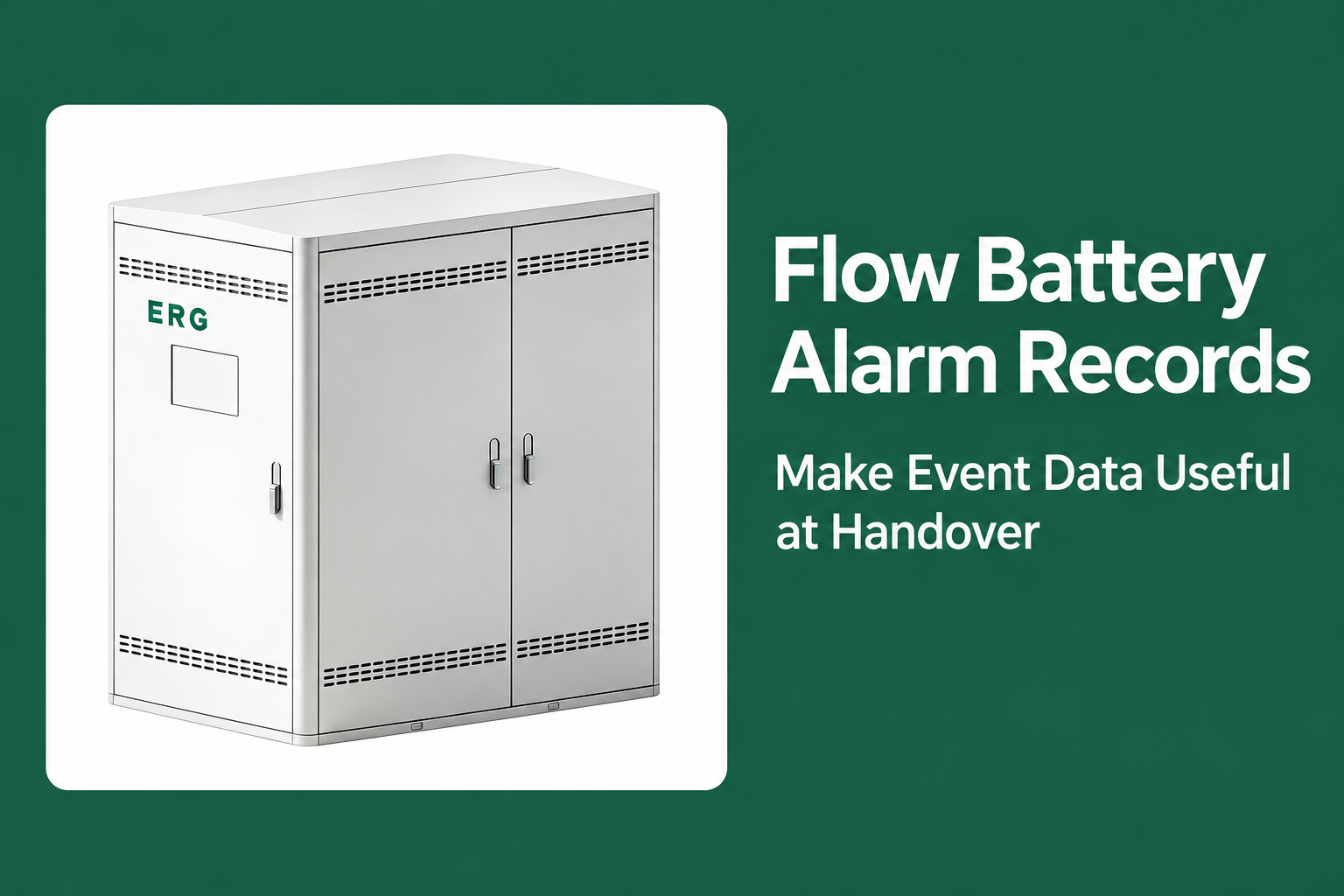
An equipment photograph cannot establish those capabilities. The presence of a cabinet, display or communications connection does not prove that a particular event history is stored. Request a documented description of the offered functions and any limitations relevant to the intended operation.
Keep the description tied to the configuration and software or document revision where applicable. A sample screen from another project may help explain a concept, but it should not be presented as a feature guarantee for the equipment being purchased.
Make time and identity unambiguous
An energy storage event log needs a usable time reference. Ask how timestamps are generated, what timezone they use and how the site handles synchronization where several devices contribute records. A sequence becomes difficult to reconstruct if one system displays local time and another exports a different basis without an explanation.
Identify equipment consistently across drawings, alarm lists and exported records. A cabinet name used on the operator screen should be traceable to the relevant device or subsystem information. If the site uses its own asset identifiers, agree the mapping before handover.
Define units and descriptions for any associated values that are provided. A number without its measurement identity, unit or timestamp may add little context. Do not assume that all measurements are sampled or stored at the same interval; obtain the actual recording characteristics from the supplier.
Separate an event description from a diagnosis
An alarm code identifies a recorded condition as defined by the system documentation. It should not be treated as a complete root-cause diagnosis without the applicable technical review. Retain the supplier's explanation and the information required to evaluate that condition.
Ask how acknowledgement, clearing and reset are represented if those functions exist in the supplied arrangement. These can describe different actions or states. A record that a message disappeared should not automatically be interpreted as confirmation that a cause was investigated and resolved.
For commissioning observations, record the conditions and approved actions taken. If a demonstration or check intentionally generates a condition, identify that context. Otherwise, the operating team may later interpret the record as an unexplained operational fault.
| Handover field | Question for the supplier or site team | Purpose |
|---|---|---|
| Equipment identity | Which device or subsystem produced the record? | Connects the event to the installed equipment |
| Timestamp | What time basis and synchronization apply? | Supports comparison across records |
| Code and description | Where is the documented meaning defined? | Avoids unsupported interpretation |
| Associated information | Which measurements or states are available? | Provides context within actual recording limits |
| Action history | How are acknowledgement and approved actions recorded? | Distinguishes observation from response |
| Retention and export | What is retained and how can authorized staff access it? | Makes later review practical |
Decide who does what when a message appears
Battery alarm response roles should be agreed with the operating organization and supplier. Identify who monitors the system, who may acknowledge a message, who assesses escalation and who is authorized to perform any specified intervention. The roles should reflect the actual site arrangement and training requirements.
Do not write universal reset instructions into a purchasing checklist. The appropriate response depends on the equipment, condition and approved procedures. An alarm list should direct authorized personnel to the applicable instruction rather than encourage them to clear a message simply to restore a normal-looking screen.
Separate routine review from emergency response. Ask the responsible project team to confirm the relevant procedures and contacts. The availability of an event log does not replace the site's safety plan or establish that every condition can be assessed remotely.
Review the record through a handover example
Ask the supplier to explain a representative record using the offered documentation. The purpose is to verify that the operator can identify the device, read the time basis, find the code meaning and locate the approved response reference. It is not necessary to invent a fault or operate equipment outside its approved procedure.
Where export is included, review an example file and its field definitions. Confirm how authorized users obtain it and which responsibilities apply to access management. A file that only one temporary commissioning account can retrieve is a weak basis for ongoing operation.
Close the information gaps before responsibility changes
- Retain the supplied monitoring-function description and its revision.
- Confirm timestamps, equipment identifiers and available data fields.
- Keep code meanings linked to the applicable documentation.
- Assign monitoring, escalation and intervention responsibilities.
- Verify authorized access to the retained records.
- Include unresolved limitations in the handover file.
Useful alarm information connects the event to a device, a time and a documented response process. Share the site's operating responsibilities with ERG when reviewing the offered system so the handover record can support the people who will actually use it.
Interested in cooperation or have questions?

Product
Content
+86-576-83200088
No. 2, Yongxing Road, Hairun Street, Sanmen County, Zhejiang Province
Copyright © Zhejiang ERG Energy LLC. All Rights Reserved.

Customized Flow Battery ODM Services for Global Energy Storage Market