 English
 中文简体

5kW Flow Battery Stack: Clarify the Pipe Interface Scope
5kW Flow Battery Stack: Clarify the Pipe Interface Scope
5kW Flow Battery Stack: Clarify the Pipe Interface Scope
5kW Flow Battery Stack: Clarify the Pipe Interface Scope
5kW Flow Battery Stack: Clarify the Pipe Interface Scope
5kW Flow Battery Stack: Clarify the Pipe Interface Scope
5kW Flow Battery Stack: Clarify the Pipe Interface Scope
5kW Flow Battery Stack: Clarify the Pipe Interface Scope
5kW Flow Battery Stack: Clarify the Pipe Interface Scope
5kW Flow Battery Stack: Clarify the Pipe Interface Scope
5kW Flow Battery Stack: Clarify the Pipe Interface Scope
5kW Flow Battery Stack: Clarify the Pipe Interface Scope
5kW Flow Battery Stack: Clarify the Pipe Interface Scope
5kW Flow Battery Stack: Clarify the Pipe Interface Scope
5kW Flow Battery Stack: Clarify the Pipe Interface Scope
5kW Flow Battery Stack: Clarify the Pipe Interface Scope

Product Category
NEW Category
5kW Flow Battery Stack: Clarify the Pipe Interface Scope
A stack quotation can identify rated power while leaving a practical installation question unresolved: what exactly connects to the pipework? A nominal connection size is useful, but it does not describe the mating face, sealing arrangement, allowable mechanical load or hydraulic conditions needed by the integration team.
ERG’s 5kW vanadium redox flow battery stack lists a DN20 pipeline interface. Treat that figure as the beginning of an interface discussion. A purchaser integrating the stack into a larger system should obtain the relevant drawings and operating data rather than selecting pipe accessories from the nominal size alone.
Draw the supply boundary first
Make a diagram showing the stack and every adjoining item that the order is expected to include. Identify pipe fittings, hoses, valves, pumps, tanks, sensors and any skid or mounting hardware. Mark which party supplies each item. A stack is one part of a complete flow battery system.
The catalogue power rating does not determine the electrolyte inventory or stored energy of the complete installation. Likewise, the presence of a connection on the stack photograph does not establish that the mating fitting is included. Resolve the physical and contractual boundaries together.
For a replacement project, provide the existing interface drawing and photographs with dimensions. Name any restrictions that cannot change, such as pipe routing or skid access. Do not assume that an apparently similar stack will fit an existing hydraulic circuit without checking its requirements.
If commissioning support is included, identify whether it covers document review, on-site assistance or a defined acceptance activity. These services should be described separately from hardware supply so the integrator knows which tasks remain its responsibility.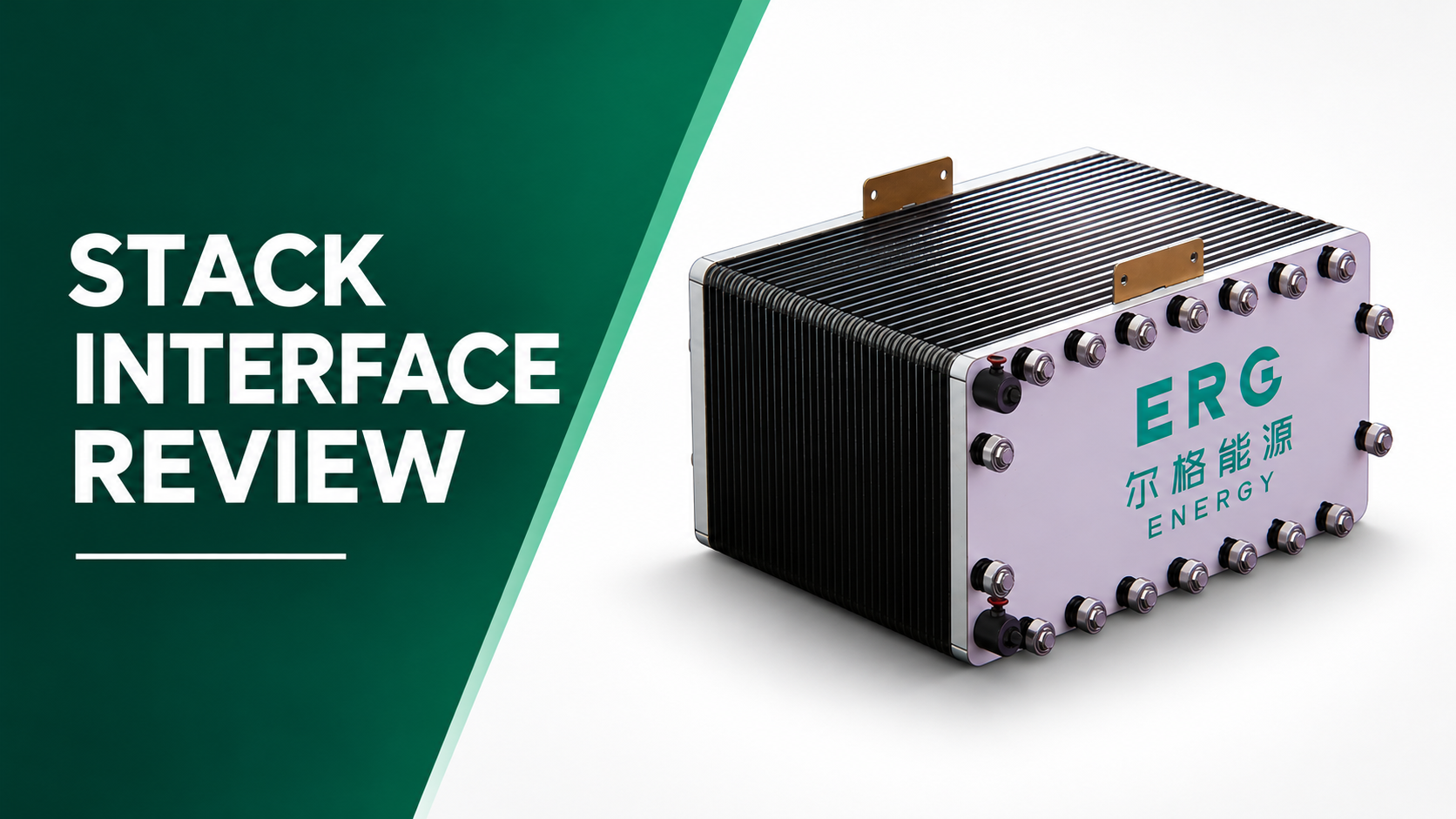
DN20 still needs a connection drawing
Ask for the exact connection type, dimensions, material and sealing method for the offered stack. A nominal diameter alone is insufficient to select a compatible connection. The mating component must fit the approved interface and be compatible with the intended fluid and conditions.
Identify the ports and flow direction clearly. The installation team should be able to distinguish connections on the drawing and on the delivered component. If labels are used, agree their location and durability for the operating environment.
| Interface information | Integration decision it supports |
|---|---|
| Port drawing and connection type | Selection of mating components |
| Flow and pressure requirements | Hydraulic circuit review |
| Wetted materials and seals | Compatibility assessment |
| Connection loading restrictions | Pipe supports and routing |
| Access requirements | Assembly and maintenance space |
Hydraulic data should accompany the hardware
Request the applicable flow range, pressure-drop information and pressure limits from the supplier for the proposed operating conditions. Do not calculate those values from the rated electrical power or the appearance of the ports. The integration design requires component-specific data.
Clarify whether the supplied information applies to a single stack or a particular assembly. Parallel branches, series arrangements and additional fittings affect the complete circuit. The system designer should review the whole hydraulic arrangement with the supplier rather than transferring one test point to every configuration.
Explain the expected start, stop and standby conditions. If the project requires draining, isolation or servicing, discuss the relevant procedures and interface provisions before ordering. These requirements can affect access and pipework layout even when the normal operating connection remains unchanged.
Keep the electrical and mechanical reviews connected
The current product table lists a 40–59 V DC range alongside the 5 kW rating. The integrator should confirm the operating envelope and electrical connection details for the ordered configuration. Catalogue figures do not replace protection design or the approved system electrical documentation.
Mechanical installation deserves the same attention. Confirm the mounting arrangement, lifting guidance and maintenance access. Pipework should not be used to force the stack into position or carry loads beyond the approved connection limits. Provide suitable support based on the confirmed installation requirements.
- Confirm the exact stack configuration and document revision.
- Obtain labelled hydraulic, electrical and mounting drawings.
- Review operating data against the proposed system duty.
- Assign responsibility for every adjoining component.
- Agree inspection and installation documentation before dispatch.
Agree how interface changes are released
Name the document that controls each connection and assign responsibility for approving changes. A supplier drawing and an integrator model can both be current within their own systems while referring to different hardware revisions. The handover should make that mismatch visible before manufacture.
If an alternative fitting or seal is proposed, review it against the fluid, operating conditions and assembly method. A part that fits the nominal diameter is not automatically an equivalent replacement. Record the accepted item and its drawing rather than relying on a verbal agreement.
Use the same boundary diagram during factory review and installation planning. Mark the items actually delivered and the items still to be supplied on site. This supports receiving inspection and reduces uncertainty when the integration team prepares the remaining pipework and supports.
Make the handover useful to the integrator
Retain the interface drawings, approved component list, operating data and any installation instructions in one controlled package. A photograph is useful for orientation, while dimensions and limits support design decisions. If a connection changes during manufacture, the document revision must follow the delivered hardware.
Distinguish incoming inspection from system commissioning. Checking that the supplied ports and fittings match the drawing does not demonstrate complete-system efficiency or performance. Those outcomes depend on the assembled system, its controls and the agreed evaluation conditions.
An enquiry built around these interfaces allows ERG and the integrator to discuss the actual installation. It also gives procurement a clear way to compare scope between quotations. A lower stack price means little if essential adjoining components or installation requirements remain undefined until the equipment arrives.
Interested in cooperation or have questions?

Product
Content
+86-576-83200088
No. 2, Yongxing Road, Hairun Street, Sanmen County, Zhejiang Province
Copyright © Zhejiang ERG Energy LLC. All Rights Reserved.

Customized Flow Battery ODM Services for Global Energy Storage Market