 English
 中文简体

Flow Battery Site Readiness: Collect Utility and Access Requirements
Flow Battery Site Readiness: Collect Utility and Access Requirements
Flow Battery Site Readiness: Collect Utility and Access Requirements
Flow Battery Site Readiness: Collect Utility and Access Requirements
Flow Battery Site Readiness: Collect Utility and Access Requirements
Flow Battery Site Readiness: Collect Utility and Access Requirements
Flow Battery Site Readiness: Collect Utility and Access Requirements
Flow Battery Site Readiness: Collect Utility and Access Requirements
Flow Battery Site Readiness: Collect Utility and Access Requirements
Flow Battery Site Readiness: Collect Utility and Access Requirements
Flow Battery Site Readiness: Collect Utility and Access Requirements
Flow Battery Site Readiness: Collect Utility and Access Requirements
Flow Battery Site Readiness: Collect Utility and Access Requirements
Flow Battery Site Readiness: Collect Utility and Access Requirements
Flow Battery Site Readiness: Collect Utility and Access Requirements
Flow Battery Site Readiness: Collect Utility and Access Requirements

Product Category
NEW Category
Flow Battery Site Readiness: Collect Utility and Access Requirements
A battery proposal can identify power and energy capacity while leaving the installation team uncertain about what must be ready on site. Electrical interfaces, access routes and service space can involve different suppliers and contractors. Flow battery site readiness begins by collecting these requirements before civil and utility work is treated as complete.
The objective is a coordinated information package for the selected system. It is not a universal installation specification. Cabinet arrangements, auxiliary equipment and site conditions vary, so dimensions, operating requirements and approvals must come from the project documentation reviewed by the responsible parties.
Define the equipment boundary
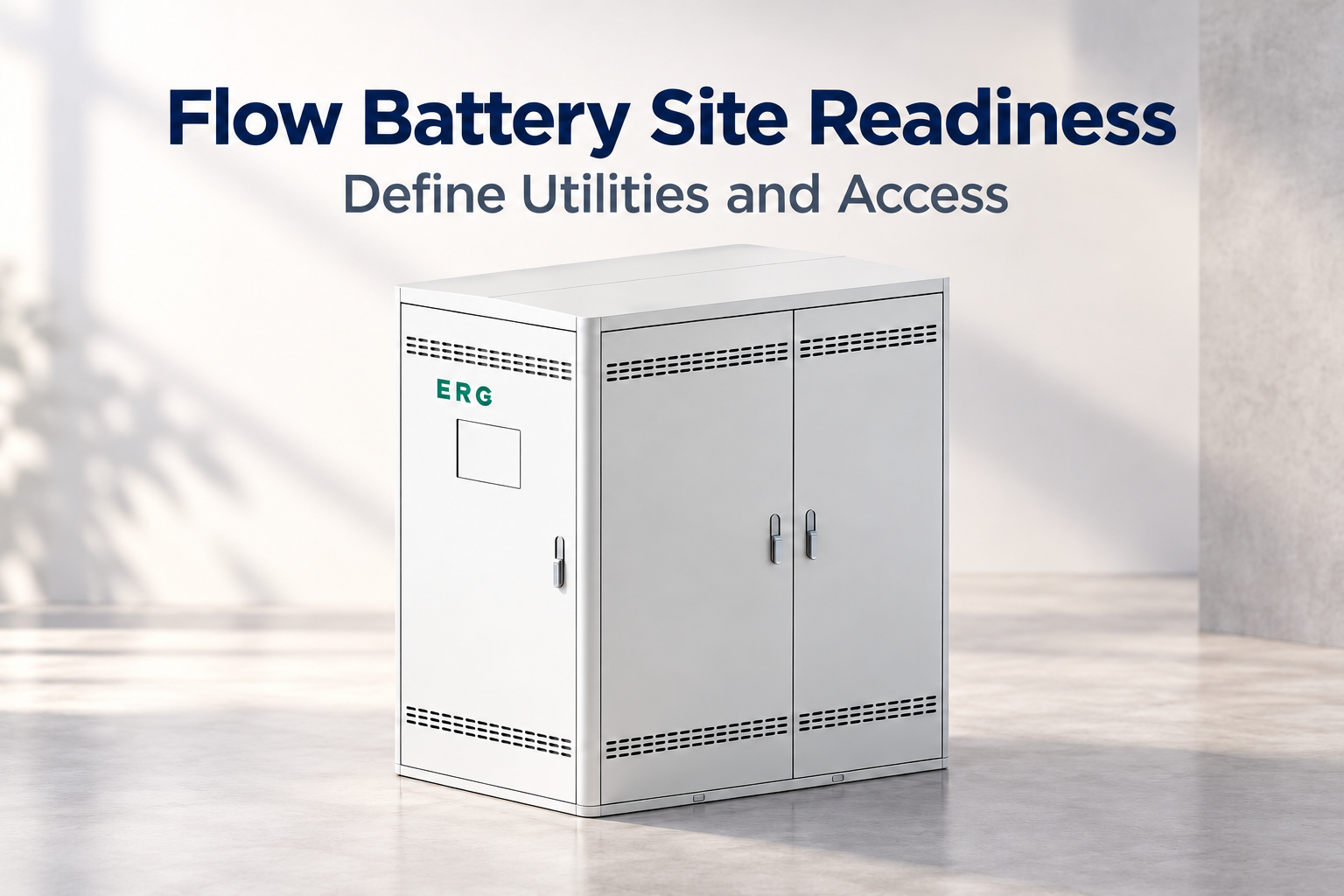
Define the supplied system boundary
Start with the proposed equipment configuration and an itemized supply scope. Identify which assemblies arrive together, which are shipped separately and which equipment is provided by the owner or another contractor. A single system description may not explain every boundary needed for installation planning.
When reviewing battery energy storage systems, request information for the exact offered configuration. A compact cabinet photograph cannot establish the layout of a larger project or show every required auxiliary. Keep the model reference and approved arrangement drawing with the site information request.
Create an interface list linking the battery supplier, electrical designer, civil designer and site operator. Assign an owner to each unanswered question. A requirement without an owner can remain unresolved until delivery even when every party assumes that someone else is handling it.
Coordinate the utility owners
Collect the electrical and control interfaces
Ask the supplier to identify the electrical connection points and the information required from the site. The responsible electrical designer should review the proposed connection, protection and earthing arrangements against the project requirements. Do not infer these details from the system's headline capacity.
Include control and communications interfaces in the same coordination exercise. Record the intended operating controller, required signals and the parties responsible for integration. A communications connection that is physically present does not by itself establish that the site and storage system use a compatible control arrangement.
Where the project involves a utility connection, confirm the applicable approval process with the relevant parties. Approval requirements are location dependent and can change. The project team should verify the current requirements for the actual site rather than treating a general product statement as authorization to connect.
Prepare an energy storage utility schedule
Request the utilities and environmental conditions required by the selected configuration. These may involve auxiliary electricity, thermal management or other services, depending on the supplied design. Ask the supplier to state what is required and what is not applicable instead of adding assumed services to the layout.
For each required utility, identify the connection location, relevant specification and party providing it. Include requirements during commissioning and maintenance as well as normal operation. A site that can support ordinary operation may still lack a temporary service needed during installation.
Keep any electrolyte-related requirements within the supplier's documentation and site engineering review. Handling, containment and emergency arrangements must suit the actual system and its documentation. Do not assume that a generic storage cabinet description explains the liquid-management requirements of the offered flow battery.
Make the readiness schedule usable
| Workstream | Information to obtain | Responsible coordination |
|---|---|---|
| Electrical connection | Interface drawing and project connection requirements | Supplier and electrical designer |
| Controls | Signals, communications and integration scope | Supplier and site controls team |
| Utilities | Required services and connection locations | Supplier and relevant contractor |
| Civil arrangement | Equipment loads, supports and approved layout | Supplier and civil designer |
| Delivery access | Shipping units and handling instructions | Supplier and logistics team |
| Service and response | Access needs and applicable emergency planning | Supplier, site operator and responsible authorities |
Record document revisions and acceptance status beside each line. Site readiness is not established by marking a general checklist complete when the underlying drawings remain preliminary. Identify which requirements must be confirmed before construction and which are checked before commissioning.
Release access and readiness information together
Build the battery installation access plan
Ask for the shipping dimensions, masses and approved handling instructions for each delivered unit. Compare them with the route from the unloading point to the installation position. Doors, turns, overhead restrictions and floor or route limitations should be reviewed by the responsible logistics and engineering teams.
The installed footprint is only one part of the space requirement. Include access for connecting services, opening panels and performing the maintenance tasks specified by the supplier. Future replacement routes may also need consideration where equipment cannot easily be removed through the original delivery path.
Avoid publishing a universal service clearance for every flow battery. The required space depends on the offered equipment and applicable project requirements. Use dimensions from the reviewed arrangement rather than estimating them from a cabinet photograph or a different installation.
Coordinate the safety and approval information
Ask which documents the supplier will provide and which submissions remain the owner's responsibility. Keep equipment evidence distinct from approval of the finished installation. A report for a component should not be presented as approval for every site arrangement.
Provide the site operator with the applicable operating and emergency information before handover. Confirm training, contact details and document access through the project plan. Readiness should include the people expected to operate and maintain the system, not only the completion of physical connections.
Release a coordinated readiness package
- Confirm the equipment configuration and supply boundaries.
- Assign owners to electrical, control, utility and civil interfaces.
- Review delivery units against the complete access route.
- Obtain the specified service and maintenance clearances.
- Track approval documents and commissioning prerequisites.
- Retain the final revisions for operation and later modifications.
Send the proposed site arrangement and known utility information with the enquiry. A documented readiness package lets the supplier identify missing interfaces early and gives the project team a clear basis for deciding when installation and commissioning can proceed.
Interested in cooperation or have questions?

Product
Content
+86-576-83200088
No. 2, Yongxing Road, Hairun Street, Sanmen County, Zhejiang Province
Copyright © Zhejiang ERG Energy LLC. All Rights Reserved.

Customized Flow Battery ODM Services for Global Energy Storage Market